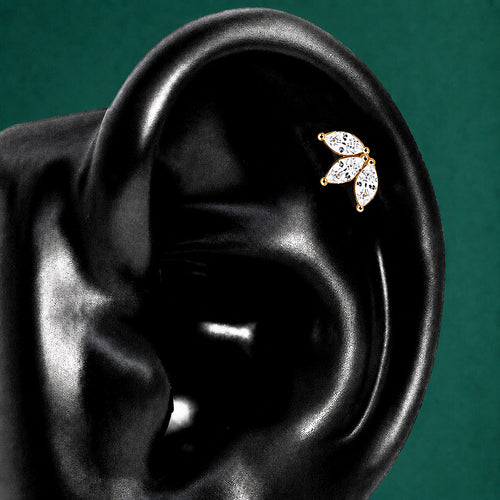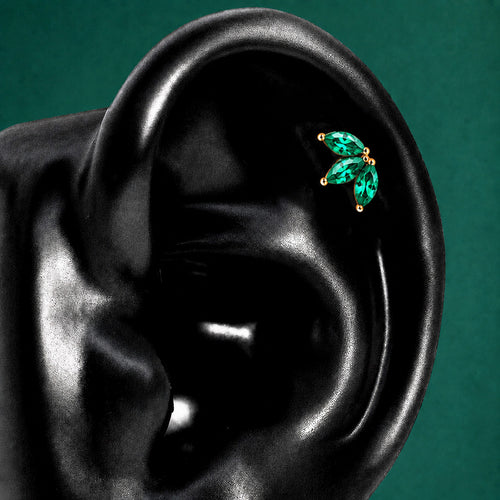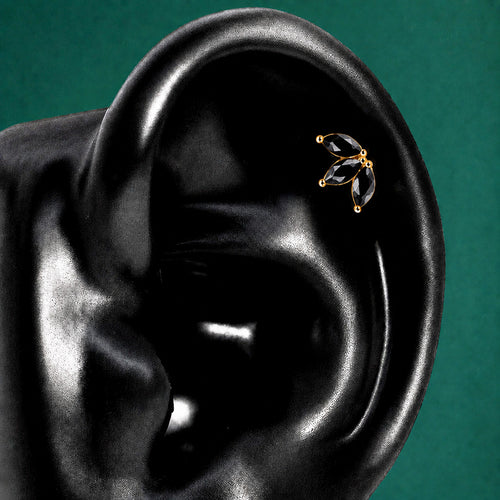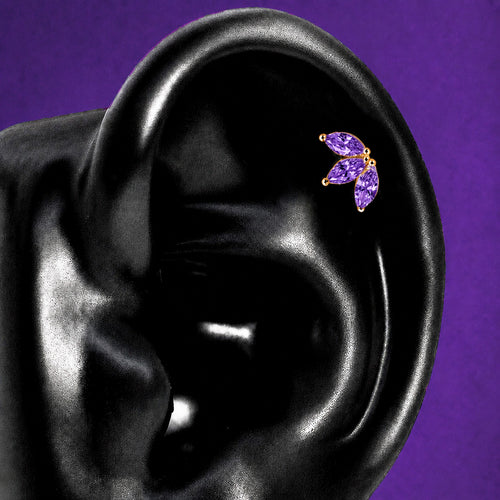

Best Stud Earrings for Daily Wear
Quick Answer
The best stud earrings for daily wear are implant-grade titanium flat back studs — they are lightweight, nickel-free, corrosion-resistant, and designed to stay comfortable whether you're sleeping, showering, or working out. For 24/7 wear, post gauge, back style, and metal composition matter far more than aesthetics alone.

Why Back Style Determines Everything About Comfort
- Front ≠ Comfort: The decorative front is secondary; the back sits against your skin all day.
- Butterfly backs: Quick and cheap, but wings press into the lobe, cause pressure points, and make sleeping uncomfortable.
- Flat-back studs: Sit flush against the ear, no raised wings, no pressure, no snagging.
- Bottom line: For daily or 24/7 wear, flat-back construction is the ergonomic and functional choice — not just a style trend.

Post Gauge and Length: The Fit Details Nobody Talks About
Getting the gauge (thickness) and post length right is as important as back style for daily comfort.
Standard lobe piercings are typically gauged at 20G (0.8mm) or 18G (1.0mm). Most ready-to-wear studs are 20G. If you've had your ears pierced with a gun rather than a needle, the gauge is usually smaller and the channel may be slightly irregular — which is one reason gun-pierced ears are more prone to irritation.
Post length needs to match your lobe thickness. A post that's too short pinches the back disc into skin; a post that's too long allows the stud to shift and wobble, creating friction. Most lobes sit comfortably with a 6mm post. Thicker lobes or cartilage piercings typically need 8–10mm. When in doubt, longer is safer — excess post length doesn't cause harm, whereas a post that's too short applies constant pressure.
Cartilage piercings require specific consideration. The tissue is denser, slower to heal, and more prone to bumps and irritation from movement. Flat back studs with longer posts are ideal for helix, tragus, conch, and daith placements. The flat disc eliminates the catching and snagging that butterfly backs create when hair brushes against them.
The Shape Guide: Which Stud for Which Situation
Not all stud shapes perform equally for daily wear.
Round studs — whether plain metal balls, CZ solitaires, or bezel-set stones — are the most universally wearable. No edges to catch on fabric, consistent weight distribution, symmetric appearance from every angle. A 3–5mm round stud is the workhorse of daily wear.
Bar studs sit horizontally across the piercing and offer an elongating effect on the lobe. They're slightly more prone to shifting than round studs since the horizontal axis creates uneven weight. A secure flat back or screw back keeps them stable.
Triangle and geometric studs have become prominent in editorial styling for their graphic, architectural quality. The key is weight — light titanium means the shape works for all-day wear without pulling.
Star studs translate well to cartilage placements, where the multi-point silhouette creates visual interest at the upper ear. Choose designs with smooth, rounded points rather than sharp tips to minimize contact irritation.
CZ (cubic zirconia) studs deliver the sparkle of diamonds at a fraction of the cost. What matters for daily wear is the setting — bezel settings (where metal wraps around the stone) are significantly more secure and comfortable than prong settings, which can catch on fabric and, over time, lose grip on the stone.
Why Metal Choice Is Not Negotiable for 24/7 Wear
Wearing earrings all day, every day exposes your metal to sweat, shampoo, pool water, saltwater, and your body chemistry. That means the metal must be safe for constant skin contact.
Nickel allergy is common
- 10–20% of people are sensitive.
- Exposure causes redness, itching, bumps, swelling, and cracked skin.
- Symptoms appear 12–72 hours after contact and are permanent once triggered.
Risks with common jewelry
- Fashion jewelry & “hypoallergenic” pieces: Often contain nickel.
- Sterling silver (925): No nickel, but tarnishes and reacts with sweat.
- Gold-plated jewelry: Thin plating wears down, exposing nickel-containing base metals.
- Stainless steel (304/316L): Contains 10–14% nickel — unsafe for sensitive ears.
Why implant-grade titanium (ASTM F136) is best
- Less than 0.05% nickel — clinically negligible.
- Self-healing TiO₂ oxide layer protects your skin.
- Surgical-grade: used in implants, dental screws, and bone anchors.
- Resistant to corrosion, tarnish, sweat, and water.
For new piercings:
- Only implant-grade titanium is recommended by the Association of Professional Piercers (APP).
- Using any other metal can lead to longer healing, keloids, and nickel sensitization.
Sleeping in Studs: What Actually Happens Overnight
Many people sleep in their earrings. For lobe piercings, well-fitted flat-back titanium studs are safe:
- The flat disc prevents pressure against the pillow.
- Titanium’s biocompatibility avoids overnight skin reactions.
Common risks:
- Butterfly backs: Dig into the lobe.
- Plated base metals: React with concentrated overnight sweat.
- Hoops & dangles: Catch on pillowcases.
Flat-back titanium studs avoid all these issues by design.
Cartilage piercings:
- Sleeping on the pierced side slows healing and causes discomfort.
- Use a travel pillow with a center cutout so the ear rests in the hole — earrings can stay in without pressure.
Studs for New Piercings
A fresh piercing is an open wound. The jewelry you start with shapes the entire healing process:
- Lobes: 6–12 months
- Cartilage: up to 18 months
Why titanium matters:
- Implant-grade titanium is mandatory for initial jewelry.
- Its TiO₂ oxide layer prevents reactions at the tissue boundary.
- Non-titanium or nickel-containing metals prolong healing, trigger inflammation, and increase the risk of lifelong nickel sensitivity.
Post length is critical:
- New piercings swell, especially in the first 72 hours.
- Initial post: 8–10mm to prevent embedding.
- After 4–6 weeks: switch to a shorter 6mm post as swelling subsides.
Comparison Table: Stud Back Styles and Metals for Daily Wear
| Stud Type | Back Style | Comfort | Skin Safety | Daily Wear |
|---|---|---|---|---|
| Titanium (round) | Flat back | 10 | Excellent | Best |
| Titanium (CZ) | Flat back | 9 | Excellent | Excellent |
| Titanium (bar) | Flat back | 9 | Excellent | Very good |
| Titanium (star) | Flat back | 8 | Excellent | Very good |
| Titanium (triangle) | Flat back | 8 | Excellent | Good |
| Sterling silver | Butterfly | 6 | Fair | Okay |
| Stainless steel | Butterfly | 6 | Poor | Limited |
| Gold-plated | Butterfly | 5 | Poor | Not ideal |
Key Takeaways
- Flat back labret studs are significantly more comfortable for daily and overnight wear than butterfly backs — they eliminate pressure points and snagging entirely.
- Post gauge (20G or 18G) and length (6–10mm depending on lobe and placement) directly affect comfort and healing.
- Round and bezel-set CZ studs are the most universally wearable shapes for 24/7 use; geometric shapes work well in titanium due to their light weight.
- Implant-grade titanium (ASTM F136) is the only metal designed for permanent skin contact — nickel-free, corrosion-resistant, and self-healing oxide layer.
- Sleeping in earrings is safe with flat back titanium studs; other backs and metals create real risks overnight.
- For new piercings, titanium is mandatory — it's the only metal that allows a clean fistula to form without inflammatory interference.
- Nickel allergy affects 10–20% of the population and is permanent once developed; earrings are the top sensitization source.
- Waterproof titanium studs require zero maintenance — shower, swim, sweat without removal.
FAQ: Best Stud Earrings for Daily Wear
What is the most comfortable back for earrings to sleep in?
Flat back labret posts are by far the most comfortable for sleeping. The disc sits flush against the skin with no raised hardware, creating zero pressure against the pillow. Butterfly backs have raised wings that press into the earlobe and cartilage during sleep, causing soreness and, over time, skin irritation. If you sleep on your side, flat back construction is non-negotiable.
Can I wear studs 24/7 without taking them out?
Yes, if the studs are implant-grade titanium with flat backs. Titanium's TiO₂ oxide layer makes it inert to all environmental exposure — sweat, water, chemicals, and chlorine — with no tarnishing or corrosion. Gold-plated and sterling silver studs should be removed before showering, swimming, and sleep because moisture accelerates tarnish and plating degradation.
How do I know if my earrings are causing an allergic reaction?
Nickel allergy symptoms include persistent redness, itching, small raised bumps, swelling around the piercing, and in severe cases, cracked or weeping skin. Symptoms typically appear 12–72 hours after exposure. If you experience these reactions consistently with certain earrings, the culprit is almost always nickel in the base metal or plating. Switch to implant-grade titanium — reactions typically resolve within days of eliminating the nickel source.
What gauge earrings are best for sensitive ears?
Standard 20G (0.8mm) is the most common and works for most lobe piercings. For cartilage piercings done with a needle, 16G (1.2mm) is standard. The metal matters more than the gauge for sensitivity — implant-grade titanium at any gauge will outperform stainless steel or plated metals at the same gauge for anyone with reactive skin.
Are CZ studs safe for new piercings?
CZ stones themselves are inert and safe. The metal setting is what determines safety. CZ studs in implant-grade titanium with bezel settings are safe for new piercings. CZ studs in gold-plated brass, stainless steel, or silver are not recommended for healing piercings because the base metals can leach irritants into fresh tissue.
How do I clean stud earrings for daily wear?
Titanium studs can be rinsed under warm running water and patted dry — that's it. For a deeper clean, a few drops of unscented soap worked around the post and disc, then rinsed, is sufficient. Avoid alcohol-based cleaners on plated metals as they accelerate coating degradation. Never use commercial jewelry polish on titanium — it doesn't tarnish and doesn't need it.
What size stud looks best on a cartilage piercing?
For helix and upper cartilage placements, 3–4mm studs (the flat disc diameter of the front piece) tend to look most proportional. The cartilage has less tissue depth than the lobe, making oversized studs feel visually heavy. For tragus and conch placements, 4–5mm creates more visual impact without overwhelming the anatomy.